
How Long Do Veneers Last?
Porcelain and E.max veneers usually last 15 to 20 years, and many last longer: in a 2025 review of 29 studies, 96% were still in place after about ten years. Composite veneers wear and stain sooner, and how you look after your veneers makes the biggest difference.
Zirconia crowns: 15+ years with good care and a five-year guarantee
How long do veneers last?
Porcelain veneers usually last 15 to 20 years, and many last longer. A 2025 review of 29 clinical studies found 96% of ceramic veneers still in place after an average of ten years, and studies that followed patients for twenty years found between 83% and 91% still working.¹ With good care, our dentists expect E.max veneers to last 15–20 years.
Composite veneers are a different product with a shorter life. They are built up from resin directly on the tooth, they stain and wear faster, and in long-term practice data they fail about three times as often each year as ceramic veneers.²
| Type of veneer | What studies show | Typical lifespan with good care |
|---|---|---|
| E.max (lithium disilicate) | 96.8% still in place after about ten years¹ | 15–20 years (our dentists' figure) |
| Feldspathic porcelain | 93.5–96% at 10 years; 83–91% at 20 years¹ | 15–20 years |
| Composite resin | About 4% fail each year, against 1.2–1.4% for ceramic² | Shorter; repairs and replacement come sooner |
"Still in place" means the veneer is still on the tooth and working, sometimes after a small repair. The sources are listed at the end of the page.
How long do E.max veneers last?
E.max is a lithium disilicate ceramic, and it has one of the best long-term records of any veneer material: in the 2025 review, 96.8% of lithium disilicate veneers were still in place after about ten years.¹ It is stronger than traditional porcelain, which means a veneer can be made thin without becoming fragile.
That thinness is part of the reason it lasts. A veneer bonds best to enamel, the hard outer layer of the tooth, and a thin veneer needs only 0.3–0.7 mm of preparation, so the bond stays in enamel. Some teeth need no preparation at all. What E.max veneers are, and how they compare with other materials, is explained in our guide to E.max veneers.
What makes veneers fail?
When a ceramic veneer has a problem, it is usually one of four things. None of them is common, and most are avoidable.
- Chipping or cracking. Usually from grinding at night or biting something hard such as ice, a pen or a bottle top. In one twenty-year study, people who ground their teeth were about eight times more likely to lose a veneer.¹
- Coming loose. Rare when the veneer is bonded to enamel; more likely when a lot of tooth has been removed and the bond sits in the softer layer beneath.
- Decay at the edge. The veneer itself cannot decay, but the tooth around its edge can, if plaque is left there.
- Gum changes. If the gum recedes over the years, the edge of the veneer can show; healthy gums and gentle brushing keep it in place.
How to make your veneers last longer
Veneers do not need special products, only good everyday habits and a little care with hard food. These six make the biggest difference:
- Brush twice a day with a soft brush and a non-abrasive toothpaste, paying attention to the edges near the gum.
- Clean between your teeth every day with floss or interdental brushes.
- Wear a night guard if you grind or clench; it is the single best protection for veneers.
- Don't use your teeth as tools: no opening packets, biting nails or crunching ice.
- Go easy on staining drinks such as coffee, tea and red wine; the ceramic keeps its colour, but the bonding edge can pick up stain.
- Keep your check-ups with your dentist every six months.
Send six photos of your smile on WhatsApp and our dentists will tell you which teeth suit veneers.
Veneers or crowns: which lasts longer?
Both last a long time; the bigger difference is how much tooth each one costs you. A veneer covers the front of the tooth and needs 0.3–0.7 mm of preparation; a crown covers the whole tooth and needs about 1–2 mm all round. With good care our dentists expect veneers to last 15–20 years and zirconia crowns 15 years or more, and crowns at TUA Dental carry a five-year guarantee.
The right choice depends on the tooth. A healthy tooth that only needs a new colour or shape is best with a veneer; a tooth that is broken, heavily filled or already crowned needs a crown. The two are compared in detail in our guide to veneers or crowns.
Signs a veneer may need attention
A veneer that needs attention usually shows it early, and a quick look by a dentist is all it takes. Contact your dentist if you notice a chip or a crack, a veneer that feels rough or loose, a dark line appearing at the edge, or a change in how your teeth meet.
If you were treated at TUA Dental, send a photo to your coordinator: our dentist looks at it and replies on WhatsApp, and tells you whether your own dentist can help or a visit is needed.
What happens when a veneer is replaced?
Replacing a veneer is usually simple. The old veneer is removed, the tooth is checked, and a new one is made on the same lightly prepared surface, so little or no extra tooth is lost. That is one reason dentists prefer to start with minimal preparation: it keeps every future option open.
How much do veneers cost?
In the UK, a porcelain or E.max veneer typically costs £750–£950 per tooth at a private clinic. At TUA Dental in Kuşadası, an E.max veneer is £185 per tooth, with hotel and VIP transfer included.
No hidden costs: the price in your treatment plan is the price you pay. Flights are not included; your coordinator helps you plan them, free of charge. A full comparison of veneer and crown prices is in our guide to how much veneers cost in the UK.
Get your free treatment plan: every tooth, its material and its price.+90 551 850 04 90
Real results
Before and after photos of smile makeovers at our clinic in Kuşadası. More are in our veneers before and after gallery.
 BeforeAfter
 BeforeAfter
 BeforeAfter
Results vary with the patient and the case. How long veneers and crowns made in Turkey last is discussed on our page How long do Turkey teeth last?
¹ Ceramic veneers: Klein and colleagues, Journal of Esthetic and Restorative Dentistry 2025 (systematic review, 29 studies: 96% at a mean of 10.4 years; lithium disilicate 96.8%); Alenezi and colleagues, Journal of Clinical Medicine 2021 (systematic review: 95.5% estimated survival at 10 years); Layton and Walton, International Journal of Prosthodontics 2012 (96% at 10 years, 91% at 20); Beier and colleagues, International Journal of Prosthodontics 2012 (93.5% at 10 years, 83% at 20; grinding raised the risk of failure about eightfold).
² Composite veneers: Mazzetti and colleagues, Dental Materials 2022 (annual failure rates of about 4% for composite and 1.2–1.4% for ceramic veneers); Lim and colleagues, Journal of Evidence-Based Dental Practice 2023 (88% over 2–8 years).
Last updated:
Your new smile starts here
Your free treatment plan in 3 steps
Step 1Fill in the form
Step 2We plan your treatment
Step 3We plan your trip
 FreeYour personal treatment plan
Your English-speaking patient coordinator will get in touch and ask you for:
- Photos of your teeth
- Your X-ray, if you have one
- Your dentist's treatment plan or quote, if you have one
From these, our experienced dentist prepares your free treatment plan – with all treatments and prices. Hotel & transfer freeYour stay in Kuşadası
As soon as your treatment plan is ready, we take care of everything else:
- Your appointment is set to fit your treatment plan.
- We arrange your hotel and VIP airport transfer (free of charge).
- We help you plan your flight free of charge.
If you wish, we go through your plan with you beforehand in a video call, by appointment.
 1Face from the front,
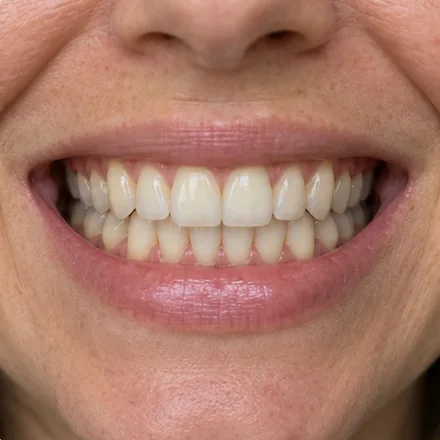 2Teeth together,
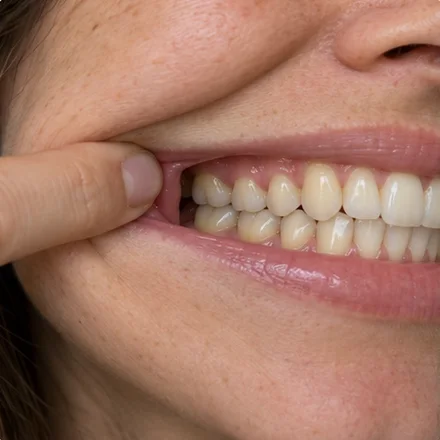 3Right side
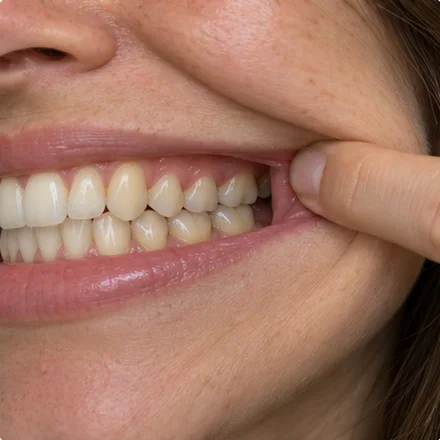 4Left side
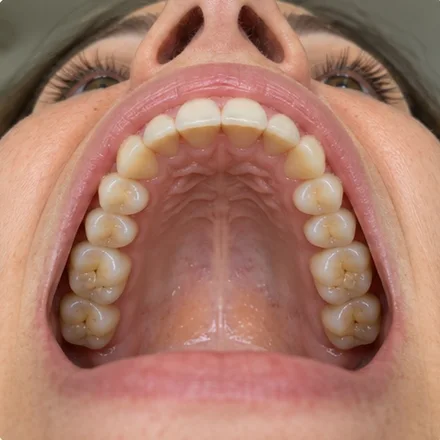 5Upper jaw
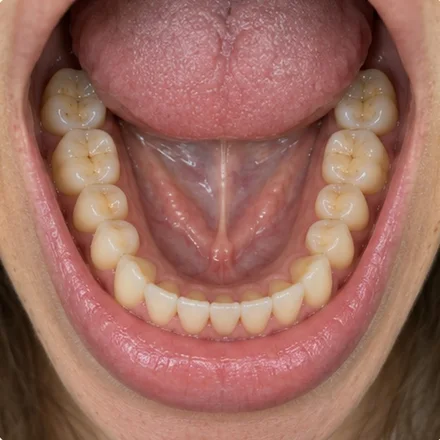 6Lower jaw
How long veneers last: frequently asked questions
How long do porcelain veneers last?
Usually 15 to 20 years, and often longer. In long-term studies about 96% of ceramic veneers were still in place after ten years, and 83–91% after twenty.
How long do E.max veneers last?
With good care, our dentists expect E.max veneers to last 15–20 years. In a 2025 review, 96.8% of lithium disilicate veneers were still in place after about ten years.
How long do composite veneers last?
Less long than ceramic. Composite stains and wears faster, and in long-term practice data it fails about three times as often each year as ceramic veneers.
Do veneers need replacing?
Eventually, yes, like any dental work, but well-made ceramic veneers often last decades. When one is replaced, the new veneer is made on the same tooth, usually with little or no extra preparation.
Can veneers last a lifetime?
Some do, especially when they were placed with minimal preparation and the patient wears a night guard. Most people should expect 15–20 years or more from ceramic veneers.
Do veneers stain?
Ceramic veneers keep their colour; they do not stain or whiten. The bonding edge can pick up a little stain over the years, which a dental hygienist can polish.
What shortens the life of veneers?
Grinding your teeth, biting hard objects, gum disease and missed check-ups. A night guard and good cleaning between the teeth prevent most problems.
Do veneers ruin your teeth?
Not when they are planned well. An E.max veneer needs 0.3–0.7 mm of preparation, and some teeth need none, so most of the tooth stays as it was.